The data fabric for institutional finance.
Broken data architecture is the root cause of every major pain point in institutional finance.
Financial institutions spend $650 billion annually on technology, yet have achieved no significant net productivity gains in 20 years. Technology spending grows at 9% while revenue grows at 4%.
The problem is not a lack of ingenuity or will — it’s paradigmatic. Most financial institutions rest upon broken data foundations, and try layering new tools on unsteady, unsurveyed ground.
29 of 31
G-SIBs still fail BCBS 239 risk data aggregation, 13 years after it was first published.
$274B
Spent globally on KYC/AML because every institution independently re-verifies the same clients.
90–95%
False positive rate on AML alerts. Billions wasted investigating legitimate transactions.
Some incumbent vendors solve vertical slices of this problem. But none solves the horizontal data layer beneath all of them. The connective tissue to power financial institutions does not exist.
Five technical shifts converged in 2024–2025.
Graph Databases
Graph databases have matured, powering the ontological layer with tools like GraphRAG.
DTCC No-Action Letter
The SEC sanctioned tokenization of DTC-custodied U.S. Treasuries on Canton Network, backed by BlackRock, Goldman, Nasdaq, and Citadel Securities. Regulators will sanction shared institutional infrastructure.
Zero-Knowledge Proofs
JPMorgan has reported 43% fraud reduction and 28% compliance cost decrease via ZKP verification. The GENIUS Act and EU eIDAS explicitly accommodate ZKP-based verification.
Real-Time Streaming
Kafka processes $2B/day for JPMorgan Kinexys alone. Flink 2.0 delivers sub-millisecond latency with exactly-once semantics. Financial-grade streaming is finally feasible.
Confidential Computing
68x cheaper over the last two years with Intel TDX as a standard cloud instance. Privacy-preserving multi-party computation can now run at scale.
The Product
A financial data fabric with cross-institutional network intelligence.
Luminata is an infrastructure platform that operates in three layers. Each is independently valuable, but they compound together.
Institutional Data Fabric
A unified semantic model that models all data within a firm via an internal financial ontology.
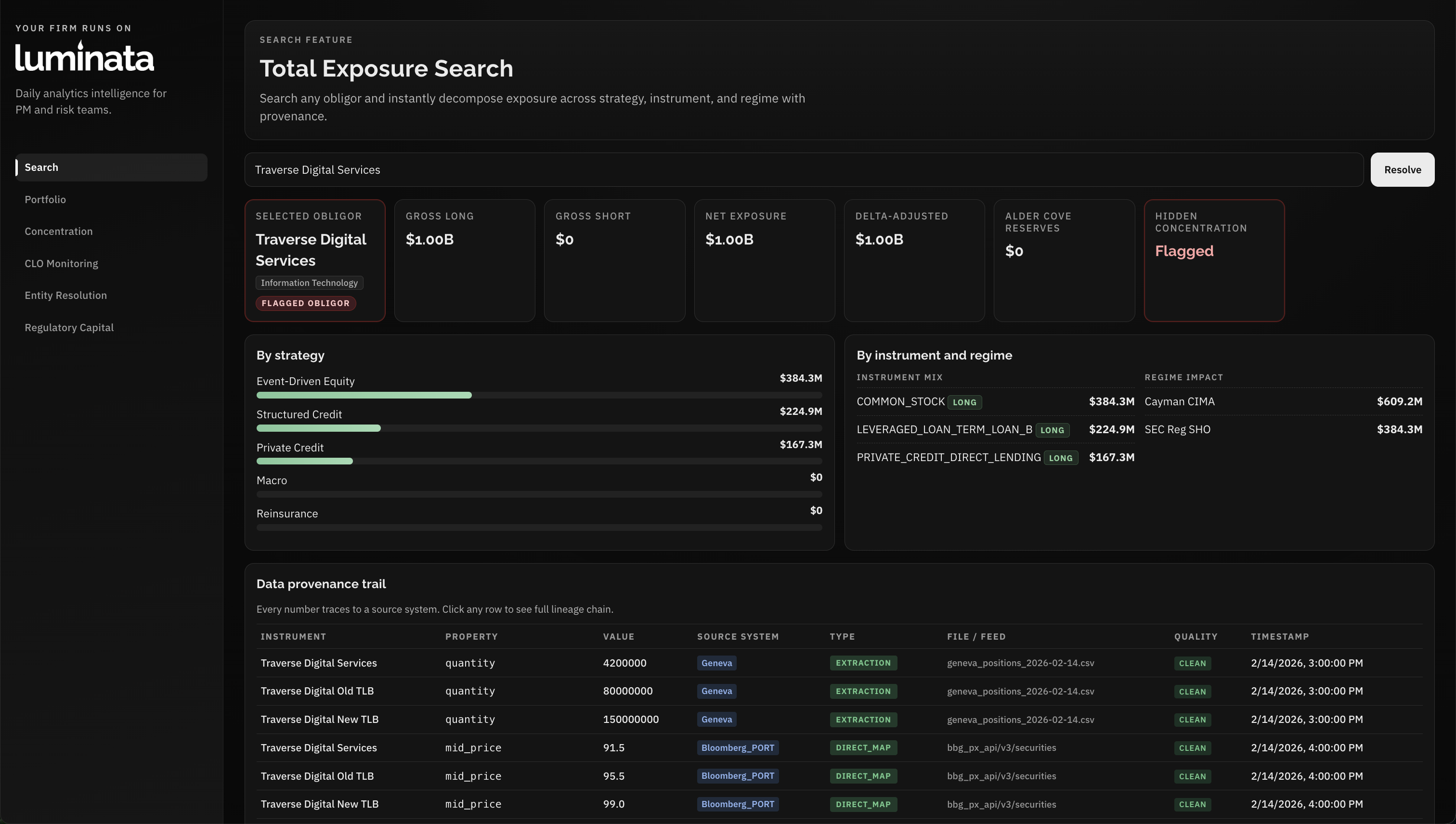
Most shops operate with disparate systems — Bloomberg for market data, vendor risk engines, front-office OMS, and compliance tools — connected ad hoc via spreadsheets, cron jobs, and Python scripts. Luminata consolidates them into a governed semantic data fabric. A single canonical model makes hard questions easy and enables BCBS 239 compliance.
Regulatory & Operational Intelligence
Real-time systems that automate common business applications on top of the data fabric.
Risk aggregation, regulatory reporting, collateral optimization, and compliance monitoring all require similar data. Today each tool builds its own version, leading to duplication and inconsistencies. With one canonical model, different business functions become different queries — instead of integrating 10 systems with overlapping pipelines, a firm integrates its source systems once.
Cross-Institutional Network Intelligence
Distribute institutional intelligence without sharing data.
Institutions are caught in a Catch-22: collective intelligence would benefit everyone, but laws and incentives prevent sharing. Using confidential computing, zero-knowledge proofs, and secure multi-party computation, Luminata’s network layer enables systemic counterparty risk visibility, KYC mutualization, cross-institutional collateral optimization, and networked regulatory reporting.
Get in Touch
Request a Demo
daniel@luminatafinance.com